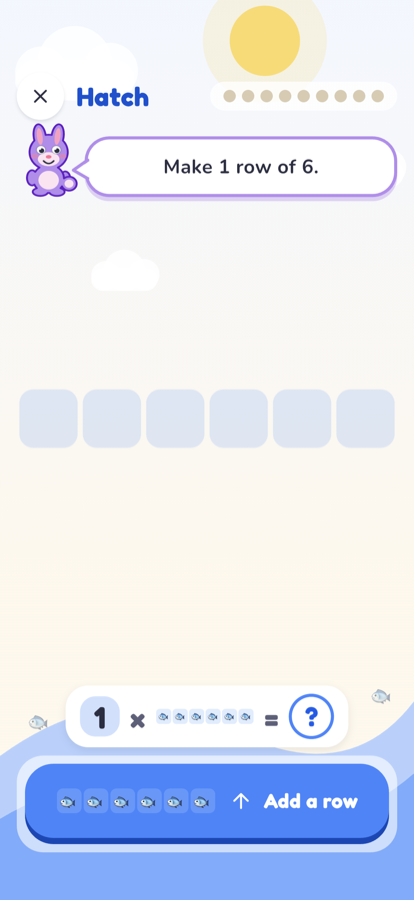
Stack equal rows, then count them.
Every tap adds one row. The running count grows in front of the child, so three rows of four arrives as four, then eight, then twelve.
3 × 4 = 4 + 4 + 4
 Multiplings
A child here does not answer flash cards. They make, hop, flip, split and share trays of real things.
Free on the App Store. Google Play is coming.

Each one is a different thing to do to the same tray, and each one is a property of multiplication a child can feel before they can name it.
Every tap adds one row. The running count grows in front of the child, so three rows of four arrives as four, then eight, then twelve.
3 × 4 = 4 + 4 + 4
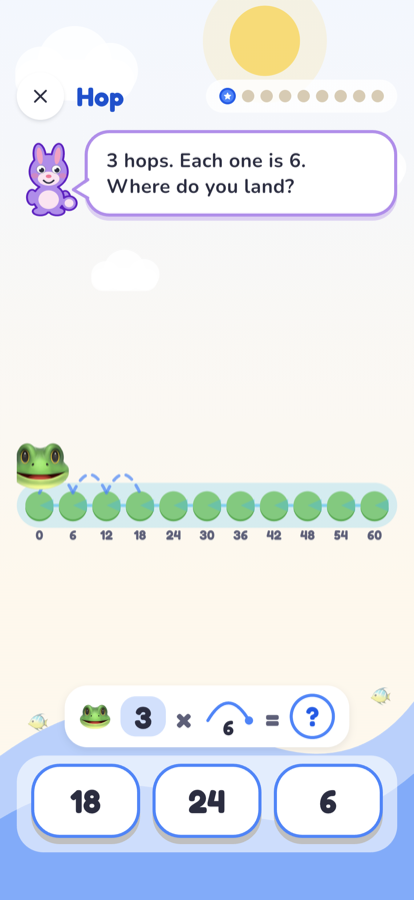
A frog takes equal jumps along a number line. Multiples stop being a list to memorise and become places a child can point at.
3 hops of 6 lands on 18
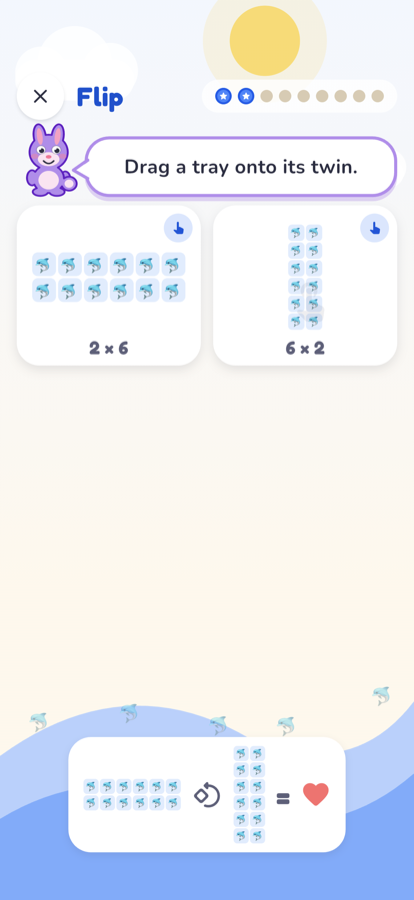
The child drags one tray onto its twin and watches it rotate. That single move halves how much there is to learn, and nobody had to say so.
6 × 3 = 3 × 6
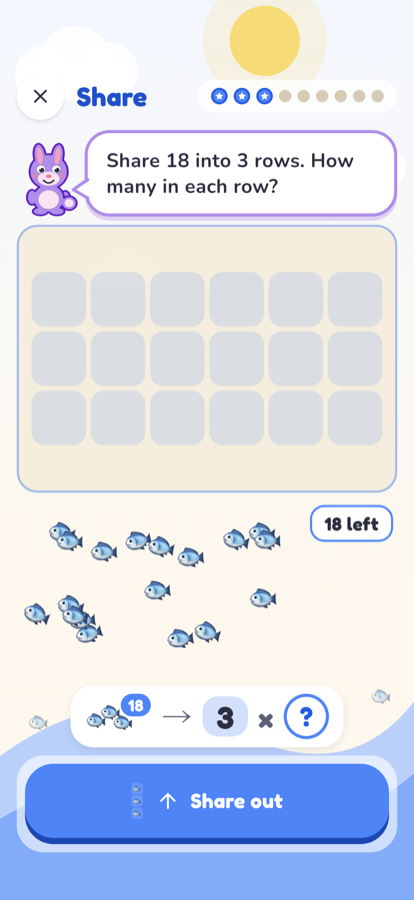
The same tray, built backwards. Division stops being a new operation and becomes multiplication with one number missing.
4 × ? = 24
Seven rows of eight is too much to count. So the child cuts it where they like, and adds two easier trays back together. This is the strategy adults actually use, and the app names it out loud.
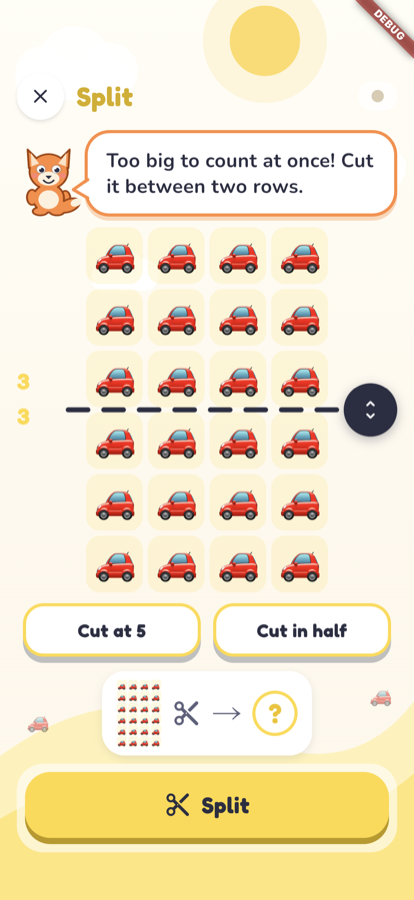
7 × 8 = ?
Too big to count at once. Cut it.
5 × 8 = 40
2 × 8 = 16
40 + 16 = 56. So seven eights are fifty-six.
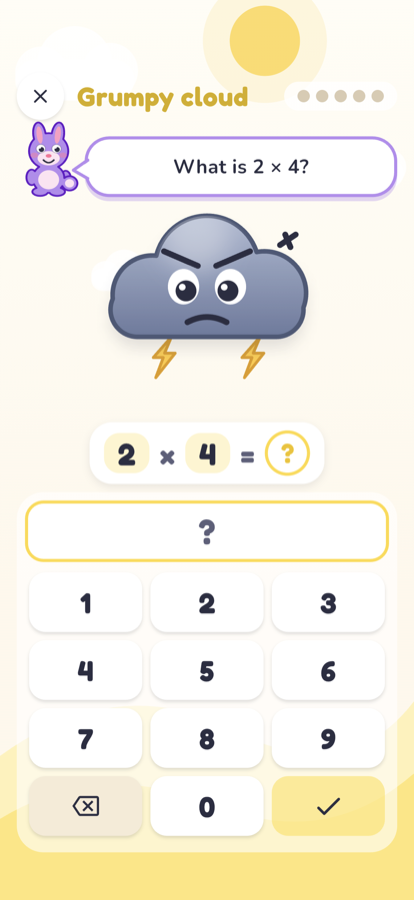
A grumpy cloud turns up now and then holding a handful of their weakest facts. Every right answer cheers it up a little, until it drifts off smiling. It is spaced repetition, and it looks like weather.
No cloud appears when there is nothing to review. A child is never sent to fight an empty one.
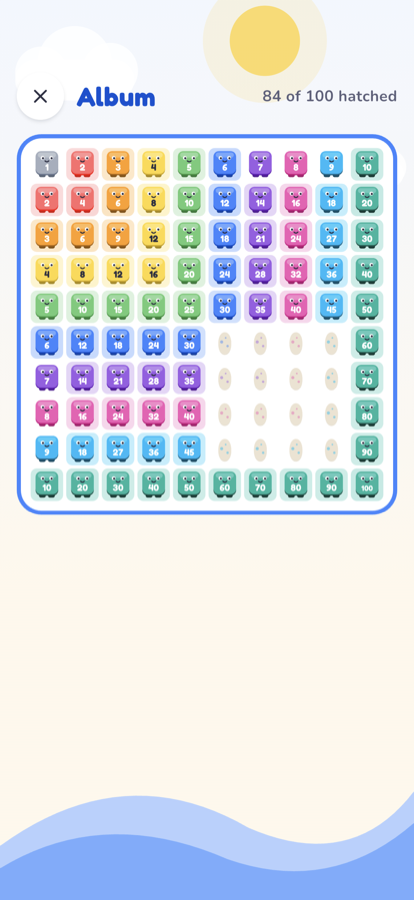
Every fact a child meets hatches into a small creature with eyes and feet, coloured by its family. Everything still to come waits as an egg. The times table stops being a table and becomes a collection.
Twenty-seven levels, nine families, in the order used by American grade 3 programmes: twos, threes, fours, fives and tens, then the hard ones.
There are no accounts and no sign-in. What your child does stays in the app's own storage on your phone. The app asks for no permissions, contains no analytics, no advertising and no tracking of any kind, and makes no network requests at all. There is no server, so there is nothing about your child anywhere to ask us to delete.
No purchase, no subscription, no adverts, nothing locked behind a paywall. The whole times table is in the app from the first minute.
No timer, no lives, no streak, no leaderboard. A wrong answer is met with a demonstration rather than a red cross, and then the question comes round again.
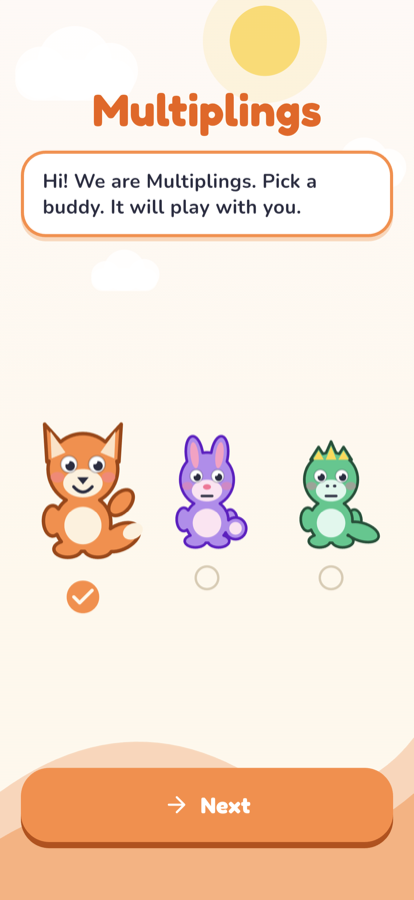
Every task is shown in pictures as well as words, so a child who cannot yet read the sentence still knows what to do. Prompts can be read aloud. Touch targets are large. The app runs entirely offline, in eight languages.
Multiplings is out on the App Store, free. Google Play is coming. There is no mailing list to join and nothing to sign up for.
Or write to me, at [email protected].